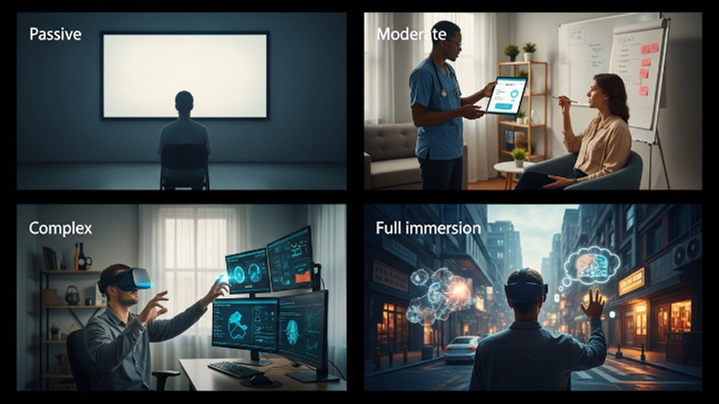
Learn how the four levels of eLearning interactivity, based on MIL-HDBK-29612-3A, affect engagement, learning outcomes, and development effort. Understanding these levels helps organizations design custom eLearning development strategies that align with mission needs and prepare personnel for operational readiness.
Defining eLearning Interactivity Levels
In digital training, interactivity defines how learners engage with content and how actively they participate in the learning process. The U.S. Department of Defense’s MIL-HDBK-29612-3A categorizes eLearning into four levels of interactivity, ranging from simple content delivery to full operational simulation and tactical simulation training. Knowing these levels allows organizations to match training design with specific goals, learner requirements, and available resources. The result is mission-ready personnel and measurable training outcomes built through structured, immersive education.
Why Interactivity Levels Matter
Understanding eLearning interactivity levels benefits more than instructional designers. For organizations, it
supports clear, evidence-based training decisions that tie directly to operational performance.
Tailored Learning Experiences
Each level supports a different purpose. Choosing the right level ensures the course design meets mission
objectives and field requirements. Custom course development allows for focused learning built around specific
operational realities.
Improved Engagement and Retention
Interactive content, such as multimedia case studies or computer simulations; keeps learners engaged longer and
improves recall during field execution.
Cost-Effective Design
Selecting an appropriate level of interactivity prevents unnecessary complexity while maintaining measurable
results. The right balance saves both time and resources.
Faster Onboarding and Compliance
Moderate interactivity, such as Level 2, supports faster learning and smoother adoption of new systems,
policies, and operational planning procedures.
Skill Mastery and Readiness
Higher levels incorporate operational simulation and causal analysis. Learners practice real-world
decision-making and develop confidence before deployment.
Performance Data and Improvement
Interactive systems provide measurable feedback. Organizations can assess comprehension, evaluate skill growth,
and adjust content based on data rather than assumptions.
Level 1 – Passive Interactivity
Overview
Level 1 delivers basic awareness training. It’s straightforward and linear, designed to communicate essential
information efficiently.
Typical Features
- Linear course flow
- Text, static images, minimal animation
- Short video or narration clips
Learner Interaction
- Navigation through “Next” or “Back” prompts
- End-of-section quizzes or simple checks
Use Cases
Compliance programs, policy introductions, and safety briefings. Level 1 is suitable when knowledge awareness is
the only goal.
Level 2 – Moderate Interactivity
Overview
Level 2 adds moderate interaction through multimedia and basic branching. It’s the most common starting point
for organizations investing in custom eLearning development.
Typical Features
- Audio, video, or animated sequences
- Clickable graphics or short interactive case studies
- Assessments with instant feedback
Learner Interaction
- Drag-and-drop activities
- Roll-over graphics and scenario-based questions
Use Cases
Onboarding programs, system familiarization, and compliance courses where active engagement supports
understanding.
Level 3 – Complex Interactivity
Overview
Level 3 focuses on realistic application. Learners solve problems and make decisions in simulated environments.
Courses often use branching logic and causal analysis to mirror field operations
Typical Features
- Detailed scenarios and multi-path decision trees
- Advanced audio, animation, and video
- Integrated operational simulation
Learner Interaction
- Role-play sequences or dialogue simulations
- Decision-based activities within realistic environments
Use Cases
Leadership and management training, operational planning, and tactical simulation training. Level 3 works when
performance under pressure is a key outcome.
Level 4 – Full Immersion and Real-Time Interactivity
Overview
Level 4 provides complete immersion through 3D interactive environments, adaptive learning systems, and
real-time feedback. It replicates field operations in controlled digital conditions.
Typical Features
- VR or AR simulations
- Real-time data capture and adaptive response
- Gamified elements such as scoring or leaderboards
Learner Interaction
- Full 3D immersive experiences using motion tracking
- Scenario-based problem solving with real-time correction
Use Cases
High-risk or high-stakes training. Examples include flight simulators, emergency response drills, or engineering
operations. Level 4 prepares learners to be fully operational before entering the field.
Comparing the Levels
Each level represents a step toward deeper engagement and more realistic skill application.
Level 1 focuses on knowledge awareness and compliance.
Level 2 develops understanding through multimedia and guided interaction.
Level 3 emphasizes operational decision-making using causal analysis and simulation.
Level 4 delivers full immersion with 3D environments and adaptive learning for mission-ready
performance.
The right choice depends on training objectives, learner experience, and available resources. Partnering with
experts in custom eLearning development helps balance cost, complexity, and training effectiveness.
Making the Right Choice
Selecting an eLearning interactivity level is a strategic decision. It determines not only the learner
experience but also how well your program aligns with mission outcomes.
- Choose level 1 for fast information delivery and awareness training
- Choose level 2 for engaging, multimedia content that builds foundational understanding
- Choose level 3 for decision-making practice and applied operational planning
- Choose level 4 for fully immersive, mission-ready simulations that build performance
confidence before deployment
Working with a development partner experienced in operational simulation ensures your content supports
measurable results and aligns with MIL-HDBK-29612-3A standards.
Conclusion
The four levels of eLearning interactivity provide a proven structure for building training that moves from
simple content delivery to fully immersive, mission-ready education. Each level serves a distinct purpose,
helping organizations design learning that supports both readiness and reliability in the field. When
interactivity aligns with mission objectives, eLearning becomes more than instruction. It becomes a practical
tool for skill development, decision-making, and operational success.
Partner with experts in custom eLearning development who understand operational simulation,
causal analysis, and tactical simulation training.
Our team builds fully immersive, mission-ready learning programs that meet MIL-HDBK-29612-3A standards and
deliver measurable performance outcomes.
Contact us to discuss how we can engineer immersive education solutions that strengthen your
workforce and prepare your teams to be fully operational.
References
1. U.S. Department of Defense. (2012). MIL-HDBK-29612-3A: Electronic Learning (eLearning)
Handbook. Washington, DC: DoD. https://www.dau.edu/tools/eLearning
2. Clark, R. C., & Mayer, R. E.(2020). E-Learning and the Science of Instruction: Proven
Guidelines for Consumers and Designers of Multimedia Learning (4th ed.). Hoboken, NJ: Wiley.
3. Pappas, C. (2021). Top eLearning Interactivity Examples and Best Practices. eLearning
Industry. https://elearningindustry.com/top-elearning-interactivity-examples-best-practices
4. Horton, W. (2012). E-Learning by Design (2nd ed.). San Francisco, CA: Pfeiffer.
5. Sitzmann, T.(2011). A Meta-Analytic Examination of the Instructional Effectiveness of
Computer-Based Simulation Games. Personnel Psychology, 64(2), 489–528.
https://doi.org/10.1111/j.1744-6570.2011.01217.x
6. Garris, R., Ahlers, R., & Driskell, J. E. (2002). Games, Motivation, and Learning: A
Research and Practice Model. Simulation & Gaming, 33(4), 441–467. https://doi.org/10.1177/1046878102238607
7. Salas, E., Wildman, J. L., & Piccolo, R. F. (2009). Using Simulation-Based Training to
Enhance Management Education. Academy of Management Learning & Education, 8(4), 559–573.
https://doi.org/10.5465/amle.8.4.zqr559