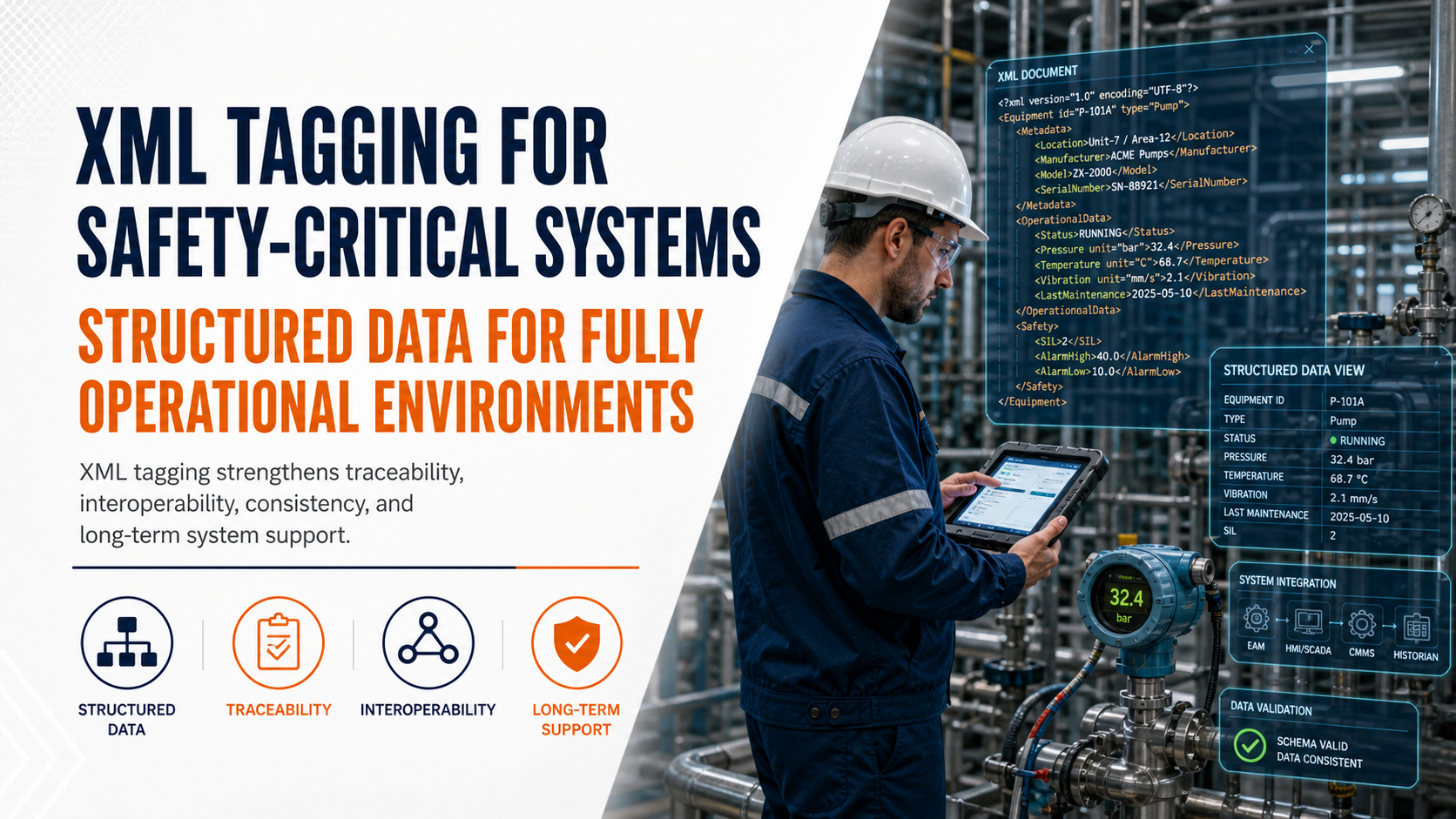
Complex infrastructure systems depend on data that is precise, traceable, and resilient over decades of service. In safety-critical environments where compliance, reliability, and accountability are non-negotiable, structured data is foundational. XML tagging remains a proven method for managing this complexity across engineering, operations, training, and long-term system support.
XML is not a legacy artifact. It is an operationally mature standard used in fully operational environments where system behavior must be deterministic, validated, and auditable.
XML Tagging in Regulated and High-Reliability Systems
XML tagging structures information using explicit semantic labels that define both content and hierarchy. This approach supports verification, traceability, and causal analysis across complex system interactions.
Because XML is self-describing and schema-validated, it enables consistent interpretation across engineering, quality, and operations teams. This reduces ambiguity during integration and supports certification activities across the full system lifecycle.
Supporting Operational Simulation and Planning
Operational simulation and computer simulation are essential tools for validating system behavior under real-world conditions. XML-tagged data provides a stable interface between simulation engines, operational planning tools, and analytics frameworks.
In fully immersive and 3D immersive environments, XML enables consistent scenario definition, asset behavior modeling, and performance measurement. This supports immersive cooperating simulations used for case studies, stress testing, and system verification.
By maintaining a common structured data layer, XML helps ensure that simulation outputs remain aligned with operational reality and documented requirements.
Enabling Mission-Ready Teams Through Structured Training Data
Mission-ready performance depends on training systems that reflect operational truth. XML tagging supports tactical simulation training, immersive education, and custom eLearning development by keeping scenarios, procedures, and assessment data synchronized across platforms.
For fully immersive training systems, XML ensures consistency between instructional content, operational constraints, and evaluation criteria. This supports custom course development programs designed to meet regulatory and organizational standards without introducing unnecessary complexity.
When combined with a partner-with-experts delivery model, XML-structured content enables scalable training deployments while maintaining local compliance and operational relevance.
Proven Reliability and Lifecycle Value
XML continues to be adopted in high-consequence domains because it is stable, well-documented, and validated in long-duration service. Its ability to support interoperability across heterogeneous systems reduces integration risk and supports high-availability operations.
Schema-based validation improves data quality, reduces configuration errors, and supports continuous improvement through measurable outcomes. These capabilities directly contribute to operational resilience and long-term maintainability.
A Foundation for Sustainable Long-Term Operations
Systems designed for continuous service require data architectures that support sustainability, precision, and accountability. XML tagging aligns with these goals by enabling transparent data exchange, durable documentation, and compliance-ready system integration.
Rather than prioritizing novelty, XML provides a disciplined approach to data management that supports long-term operational planning and responsible system evolution.
Final Perspective
XML tagging delivers structure, clarity, and assurance in environments where failure carries significant consequences. Its role in operational simulation, immersive education, and fully operational systems demonstrates its ongoing relevance in modern engineering contexts.
D & R provides logistics support through XML tagging in compliance with a variety of military standards. Publishers utilize the required Document Type Definition (DTD) to apply XML tags using XML authoring software, such as Arbortext Editor. The resulting XML file is a well-formed document that is compliant with the DTD and selected MIL-STD.
This XML can be used with a stylesheet to generate a PDF or can be developed for IETM viewers, such as the Army’s Interactive Authoring and Display Software (IADS), as necessary. This format supports program longevity due to the ease of maintaining and updating the files as needed.
Additional Sources & Industry References
1. World Wide Web Consortium (W3C)
Extensible Markup Language (XML).
https://www.w3.org/XML/
2. World Wide Web Consortium (W3C)
XML Schema Definition (XSD) 1.1.
https://www.w3.org/TR/xmlschema11-1/
3. ISO/IEC — Markup Language Standards
International Organization for Standardization / International Electrotechnical Commission. ISO/IEC 8879:
Standard Generalized Markup Language (SGML).
https://www.iso.org/standard/16387.html
4. CENELEC — Railway RAMS & Safety Standards
European Committee for Electrotechnical Standardization (CENELEC). EN 50126, EN 50128, EN 50129: Railway
Applications — RAMS and Safety-Related Systems.
https://european-standards.com/top-european-standards/n-50126-en-50128-en-50129-railway-applications/